

Natural foot roll in safety shoes is important because it protects the entire musculoskeletal system. When the foot can roll naturally from the heel, across the sole, to the toes while walking, the load is distributed evenly across the joints, muscles, and spine. People who spend many hours a day standing or walking at work benefit from this the most. The following questions provide specific answers about what really matters.
What happens to the musculoskeletal system when the rolling motion is blocked?
When the natural rolling motion is restricted, the body compensates for this lack of movement by making compensatory movements in the ankles, knees, hips, and back. This results in uneven stress distribution and increased muscle tension. In turn, this can lead to pain or joint wear and tear over the long term. These effects are significantly exacerbated, especially during long work shifts.
A rigid safety shoe that guides the foot like a splint forces the entire body to walk differently than it naturally would. The calf muscles shorten, the Achilles tendon is under constant strain, and the hip flexors work in a way they cannot sustain for long periods of time. This often results in discomfort that, at first glance, seems unrelated to the shoe: back pain, knee pain, and neck tension.
From an occupational health perspective, musculoskeletal disorders are among the most common causes of absenteeism. Poor footwear ergonomics is a factor that builds up over months and years and is often not recognized until it is too late.
How does an ergonomic safety shoe support the natural rolling motion of the foot?
An ergonomic safety shoe supports the foot's natural roll-off motion through the use of flexible materials, a special sole geometry, and a toe box that allows the toes ample room to move. Together, these three factors enable the foot to maintain its natural range of motion rather than being forced into a rigid position.
Specifically, it is important that the forefoot area of the shoe allows for sufficient mobility so that all five metatarsophalangeal joints are engaged in the foot’s rolling motion while walking. At the same time, the shoe should provide a secure fit in the heel area without causing unnecessary pressure or restricting movement. A balanced design that takes into account both the necessary protective functions and the most natural possible range of motion is therefore crucial.
Well-designed safety shoes meet the requirements of the relevant safety standards while also taking into account the foot's natural range of motion. It is important to strike the right balance between protective function, fit, and roll-off characteristics.
What is the difference between a barefoot shoe and an ergonomic safety shoe?
A barefoot shoe minimizes all restrictions on the foot: no cushioning, no heel-to-toe drop, no structured support. An ergonomic safety shoe, just like a barefoot safety shoe, aims to provide similar freedom of movement, but at the same time must offer certified protection in accordance with EN ISO 20345 for use in a work environment—for example, against punctures or slipping hazards. That is the fundamental difference.
Casual barefoot shoes are designed for unpredictable surfaces and individual activity patterns. However, they are not suitable for work environments where safety requirements according to EN ISO 20345 or similar standards apply. A certified barefoot safety shoe, on the other hand, combines the principles of barefoot walking with the necessary protective features of a safety shoe.
In practice, this means: a zero-drop design with no raised heel, a wide toe box that doesn’t constrict the forefoot, and flexible material combined with an integrated toe cap and puncture resistance. The foot remains straight and upright, can move naturally, and is still protected. This is an improvement over a traditional safety shoe designed for comfort.
Which occupational groups benefit the most from ergonomic safety shoes?
Workers who spend many hours a day standing or walking benefit the most from ergonomic safety shoes. This includes, above all, workers in logistics, the trades, manufacturing, and construction. The longer the shoes are worn each day, the greater the difference a well-designed shoe can make.
In logistics, for example, order pickers and warehouse workers are often on their feet for eight to ten hours at a time. In these situations, improper strain can quickly add up. The same is true for tradespeople who work on varying surfaces and must constantly make compensatory movements.
Workers in industrial manufacturing who work at standing workstations are also part of the at-risk group. Standing in one spot for hours on end puts strain on the feet, knees, and back in a different—but equally one-sided—way. A well-fitting safety shoe with natural roll-off properties can help distribute the strain more evenly.
Can wearing the wrong safety shoes cause back and knee pain?
Yes, wearing the wrong safety shoes can cause back and knee pain or aggravate existing conditions. This is because the foot, knee, hip, and spine are biomechanically interconnected. If the shoe alters your gait, it affects the entire chain.
A heel that is too high shifts the body’s weight forward and increases pressure on the kneecap and lumbar spine. A sole that is too stiff prevents the foot from rolling naturally and forces the body to compensate, which puts strain on the hips and back. A toe box that is too narrow alters the distribution of pressure in the forefoot and can disrupt the foot’s overall stability, as well as lead to foot misalignments.
That doesn't mean that all back pain is caused by shoes. But anyone who experiences regular discomfort and spends a lot of time in safety shoes should consider footwear as a possible contributing factor. Switching to a more ergonomically designed model is often a sensible first step before considering more extensive measures.
How can you tell if a safety shoe has truly good roll-off characteristics?
You can identify a safety shoe with good roll-off characteristics by three specific features: a flexible sole in the area of the metatarsophalangeal joints, a wide toe box that allows room for movement in the forefoot, and a sole design without excessive heel elevation. You can check these features yourself before you buy the shoe.
- Sole flexibility: Bend the shoe at the point where your toes would bend. A good shoe will give way there. If it’s hard to bend, it will restrict exactly the movement that matters most.
- Toe box: Check the width in the forefoot area. The toe box should be wide enough that your toes can spread out easily without pressing against the material.
- Heel-to-toe drop: The heel-to-toe drop refers to the difference in height between the heel and the forefoot. The smaller the heel-to-toe drop, the more upright the body stands. A heel-to-toe drop of zero millimeters, as found in barefoot safety shoes, promotes a neutral posture.
- Fit: No ergonomic feature will help if the shoe doesn't fit. The length, width, and volume must match the shape of your individual foot. Always try on shoes at the end of the workday, when your feet are slightly swollen. You can find more tips on proper fit here.
Certifications based on current safety standards tell you what the shoe protects against. What they don't tell you is how well it supports your foot's natural roll. The best way to assess this is to evaluate the features mentioned above yourself or try the shoe on at a specialty store before buying it.
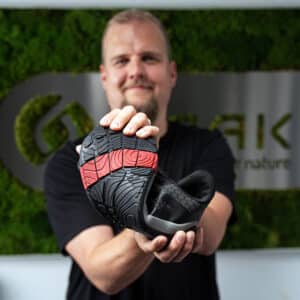
How BAAK Helps with Natural Rolling
Here at BAAK, we have been developing safety shoes for 35 years with a clear focus on foot health. Our approach is not to view protection and freedom of movement as an “either/or” choice, but to consistently combine the two.
This is specifically reflected in the following features of our safety shoes:
- Patented Baak Go&Relax System: The combination of the Flex Cap, Flex Zone, and H-Joint in the outsole allows for natural flexion at the metatarsophalangeal joints. This can help reduce the risk of musculoskeletal disorders.
- Barefoot Safety Shoes with Zero-Drop: Our certified barefoot safety shoes bring the benefits of barefoot walking to the workplace: 0 heel-to-toe drop, extra-wide toe box, and ultra-flexible sole and upper materials.
- Wide Selection of Fits: Since no two feet are alike, we offer a variety of widths and fits to ensure the shoe fits perfectly.
- Partnership with Specialty Retailers: We work closely with specialty retailers to ensure you receive expert advice and don't just buy any old pair of shoes.
If you'd like to know which model is right for your daily work routine and your feet, feel free to contact us or visit our online store to explore our selection for yourself.
Related Articles
- Are barefoot safety shoes suitable for people who wear insoles?
- What is the difference between S1P and S3 barefoot safety shoes?
- What does "zero drop" mean in safety shoes?
- What should you keep in mind when buying barefoot safety shoes for the first time?
- What does "natural freedom of movement" mean in safety shoes?